One of the most common mistakes in cybersecurity is analyzing threats as if the company were an isolated environment.
The reality is different: Most threats originate outside the organization and are constantly adapting to the global context.
Therefore, a SWOT analysis focused on cybersecurity cannot be limited to reviewing internal controls; it must connect the reality of the company with what is happening in the digital world and become the basis of the management system, risk analysis, training, and recurring action plans.
Why is thinking that “risk is internal” a mistake?
The assets are within the company, however:
- The attackers are out.
- The attack campaigns are global.
- Vulnerabilities are exploited at scale.
- Vendors and the cloud expand the attack surface.
Analyzing risks solely within the company leads to:
- Possible misinterpretation of security maturity.
- Incorrect prioritization of controls.
- Training disconnected from the external context.
- Reactive action plans.
SWOT analysis allows break this limited vision.
SWOT analysis in cybersecurity: Connecting inside and outside
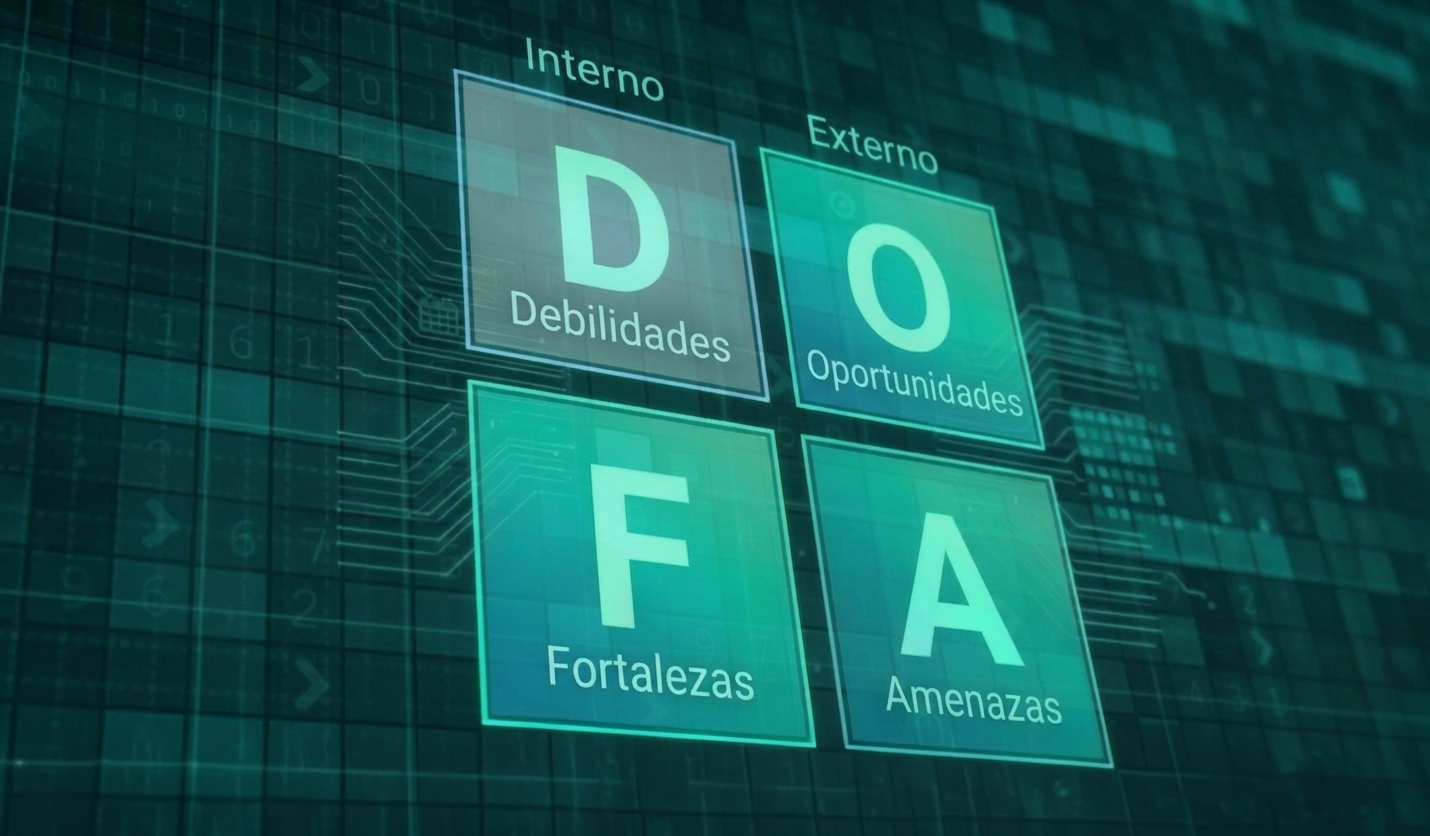
A SWOT analysis applied to the business context unites two worlds:
Internal focus
- Strengths: Controls, processes, technological and human capabilities.
- Weaknesses: Technical, human, and organizational gaps.
External focus
- Threats: Global trends in potential threats and actual attacks.
- Opportunities: Technological innovation, best practice frameworks, and regulatory compliance standards.
This intersection is what makes SWOT a tool strategic and effective.
Global threats that impact businesses today
The threats that must be considered in the SWOT and risk analysis are happening now:
- Targeted ransomware, focused on specific sectors and companies.
- Phishing and social engineering now powered by artificial intelligence.
- Supply chain attacks, using third parties and suppliers as a gateway.
- Cloud services showcase due to insecure configurations and/or technologies or those not developed with best practices.
- Credential theft as one of the initial vectors of attack.
Ignoring these trends leaves the risk analysis incomplete from the start.
SWOT as a basis for realistic risk analysis
The true value of SWOT analysis lies not in listing strengths, weaknesses, opportunities, and threats without a purpose, but in analyzing how they interact with each other and what decisions result from that intersection.
In cybersecurity, this analysis allows us to move from an inventory of controls to a real understanding of the risk.
1. Use strengths to address threats (S–T)
The first key analysis is to identify what internal capabilities allow reducing the probability or impact of external threats.
For example:
- A Security Operations Center (SOC) or continuous monitoring can reduce the impact of targeted ransomware campaigns.
- Implemented and configured identity and access controls reduce the risk of credential theft.
- Mature Continuous Vulnerability Detection processes allow for the timely identification of vulnerabilities and agile remediation to prevent the massive exploitation of flaws.
Here the risk does not disappear, but the level that the organization has in the face of real threats is understood.
2. Take advantage of opportunities to cover weaknesses (D-O)
This crossroads is one of the most overlooked and, at the same time, most valuable. It allows us to identify how:
- New technologies
- Reference frameworks
- Specialized external services
- Changes in the environment
They can be used to close internal gaps that increase risk.
For example:
- A weakness in awareness can be addressed with training programs based on real threats.
- The lack of visibility in the cloud can be mitigated by adopting security posture tools or configuration best practices.
- Internal resource limitations can be offset by hybrid models or specialized external services.
Here, the SWOT analysis becomes an enabler of the improvement plan, not just a diagnosis.
3. Understanding when a weakness amplifies a threat (D-T)
This analysis is key to prioritizing risks. A global threat can be critical or manageable depending on internal weaknesses.
- Ransomware + untested backups = high impact.
- Phishing + low awareness = high probability.
- Third-party attacks + lack of controls and supplier management = systemic risk.
This cross-section explains why certain risks should be prioritized, regardless of their frequency in the market.
4. Translate the SWOT analysis into risk scenarios
When the SWOT analysis is done in this way:
- The probability of risks materializing is adjusted to the real context of the company.
- The impact is analyzed in terms of operations, business, and compliance.
- The risk ceases to be generic and becomes a concrete and understandable scenario for the company.
Thus, risk analysis ceases to be a theoretical exercise and becomes a decision-making tool.
A SWOT analysis from this perspective not only answers what we have or what we lack, but also:
- What threats do we face today?
- How prepared are we really?
- Where to invest to effectively reduce risk
That is the point where SWOT becomes the basis of a realistic and business-aligned risk analysis.
If the threats come from outside, people must be prepared to face them.
From analysis to action plan
The ultimate value of the SWOT analysis lies in its application.
Allows:
- Define a cybersecurity roadmap.
- Prioritize controls based on real threats.
- Justify investments based on risk.
- Measuring maturity and continuous improvement.
When threats are understood as external and changing, Management ceases to be reactive and becomes strategic.
In conclusion…
Threats don't originate solely within companies. They arise in a global, dynamic, and increasingly sophisticated digital ecosystem.
A SWOT analysis focused on cybersecurity, aligned with global trends:
- Connect the world with the reality of business
- Strengthens risk analysis
- Make cybersecurity a strategic decision
Better protection involves understanding the threat environment, managing internal vulnerabilities, and detecting them early.
0 Comments